Automotive vehicle showcase campaign
- 6 shots
- Vehicle showcase
- Model included
- Landscape grid
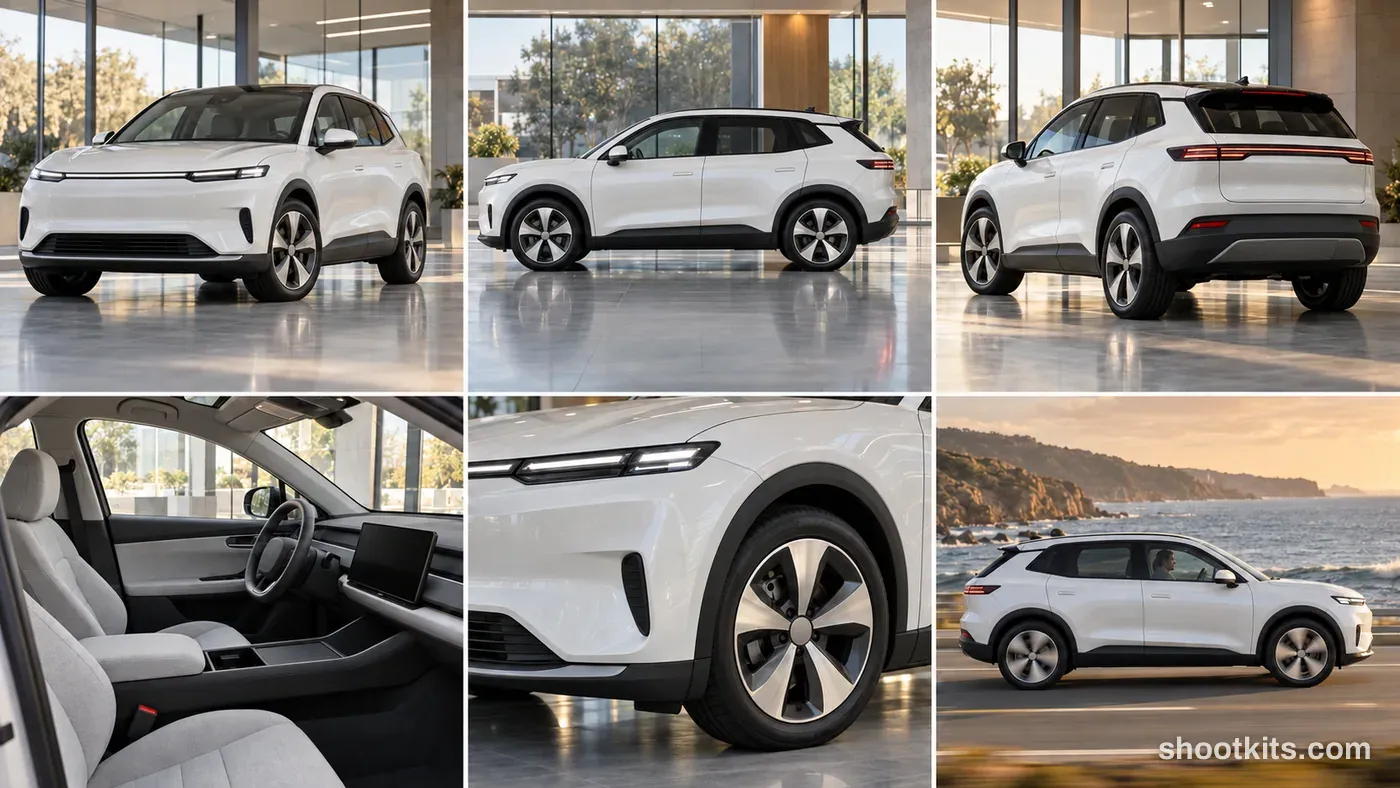
A vehicle campaign should give prospective buyers useful perspectives as well as a strong first impression. This board combines exterior angles, cabin detail and a road scene, suiting dealerships, vehicle listings and automotive launch concepts. In ChatGPT, upload front, side, rear and interior photographs of the same vehicle if available. Ask it to retain the actual wheels, lights and trim across every panel, then compare the generated views with those references before selecting images for customer-facing use.
Describe your car product in a few words. Still attach your product photo in ChatGPT.
Attach your product photo before you paste the prompt. A plain background and even light give the most accurate result.
Shot list
Want one shot at full size? Open it and copy its prompt on its own.
R1C1Front three-quarterShow the full vehicle from the classic front three-quarter angle
Create one photorealistic campaign photograph, not a grid. Input: ONLY [PRODUCT REFERENCE / PRODUCT DESCRIPTION]. Campaign route: Vehicle showcase. Creative concept: Dealership-grade vehicle photography: the supplied car shown as the hero product from the angles buyers expect. Example art direction: Clean modern showroom and an open coastal road at golden hour; unbadged, no number plates. Example palette: white, graphite, golden hour. Derive the final colors, casting, styling and set from the supplied product. No separate outfit, model or location input is required. Choose one suitable adult model internally and keep face, hairstyle, skin tone, proportions and supporting styling consistent across this campaign. Casting may differ between campaigns. Preserve the product reference's exact design, color, material, geometry, construction, size, packaging and visible branding. Preserve the supplied vehicle's exact body shape, paint color, wheels, lights and trim; remove or blur number plates; never add badges. Adapt any shot involving a pump, cap, cuff, sleeve, strap, container, animal or ingredient to what actually exists; do not invent absent features, accessory products, ingredients, performance claims or internal mechanisms. Example colors and materials are creative cues: substitute the supplied product's true characteristics. Keep skin, fur, hands, fabric behavior, scale, physical contacts, reflections and shadows plausible. No captions, panel numbers, invented logos, watermark or screenshot UI. Shot R1C1: Front three-quarter. Action: Show the full vehicle from the classic front three-quarter angle. Camera: low front three-quarter. Framing: full vehicle. Where a subject is present, reuse the campaign's internally generated hero for face, animal and styling continuity. Product-only framing contains no human or animal. Full-body framing includes complete head and feet; full-animal framing includes complete head, tail and paws.R1C2Side profileShow the clean side profile with wheels straight
Create one photorealistic campaign photograph, not a grid. Input: ONLY [PRODUCT REFERENCE / PRODUCT DESCRIPTION]. Campaign route: Vehicle showcase. Creative concept: Dealership-grade vehicle photography: the supplied car shown as the hero product from the angles buyers expect. Example art direction: Clean modern showroom and an open coastal road at golden hour; unbadged, no number plates. Example palette: white, graphite, golden hour. Derive the final colors, casting, styling and set from the supplied product. No separate outfit, model or location input is required. Choose one suitable adult model internally and keep face, hairstyle, skin tone, proportions and supporting styling consistent across this campaign. Casting may differ between campaigns. Preserve the product reference's exact design, color, material, geometry, construction, size, packaging and visible branding. Preserve the supplied vehicle's exact body shape, paint color, wheels, lights and trim; remove or blur number plates; never add badges. Adapt any shot involving a pump, cap, cuff, sleeve, strap, container, animal or ingredient to what actually exists; do not invent absent features, accessory products, ingredients, performance claims or internal mechanisms. Example colors and materials are creative cues: substitute the supplied product's true characteristics. Keep skin, fur, hands, fabric behavior, scale, physical contacts, reflections and shadows plausible. No captions, panel numbers, invented logos, watermark or screenshot UI. Shot R1C2: Side profile. Action: Show the clean side profile with wheels straight. Camera: eye-level side. Framing: full vehicle. Where a subject is present, reuse the campaign's internally generated hero for face, animal and styling continuity. Product-only framing contains no human or animal. Full-body framing includes complete head and feet; full-animal framing includes complete head, tail and paws.R1C3Rear three-quarterShow the rear design and lights
Create one photorealistic campaign photograph, not a grid. Input: ONLY [PRODUCT REFERENCE / PRODUCT DESCRIPTION]. Campaign route: Vehicle showcase. Creative concept: Dealership-grade vehicle photography: the supplied car shown as the hero product from the angles buyers expect. Example art direction: Clean modern showroom and an open coastal road at golden hour; unbadged, no number plates. Example palette: white, graphite, golden hour. Derive the final colors, casting, styling and set from the supplied product. No separate outfit, model or location input is required. Choose one suitable adult model internally and keep face, hairstyle, skin tone, proportions and supporting styling consistent across this campaign. Casting may differ between campaigns. Preserve the product reference's exact design, color, material, geometry, construction, size, packaging and visible branding. Preserve the supplied vehicle's exact body shape, paint color, wheels, lights and trim; remove or blur number plates; never add badges. Adapt any shot involving a pump, cap, cuff, sleeve, strap, container, animal or ingredient to what actually exists; do not invent absent features, accessory products, ingredients, performance claims or internal mechanisms. Example colors and materials are creative cues: substitute the supplied product's true characteristics. Keep skin, fur, hands, fabric behavior, scale, physical contacts, reflections and shadows plausible. No captions, panel numbers, invented logos, watermark or screenshot UI. Shot R1C3: Rear three-quarter. Action: Show the rear design and lights. Camera: low rear three-quarter. Framing: full vehicle. Where a subject is present, reuse the campaign's internally generated hero for face, animal and styling continuity. Product-only framing contains no human or animal. Full-body framing includes complete head and feet; full-animal framing includes complete head, tail and paws.R2C1Cabin viewShow the real dashboard and seats from the driver's door
Create one photorealistic campaign photograph, not a grid. Input: ONLY [PRODUCT REFERENCE / PRODUCT DESCRIPTION]. Campaign route: Vehicle showcase. Creative concept: Dealership-grade vehicle photography: the supplied car shown as the hero product from the angles buyers expect. Example art direction: Clean modern showroom and an open coastal road at golden hour; unbadged, no number plates. Example palette: white, graphite, golden hour. Derive the final colors, casting, styling and set from the supplied product. No separate outfit, model or location input is required. Choose one suitable adult model internally and keep face, hairstyle, skin tone, proportions and supporting styling consistent across this campaign. Casting may differ between campaigns. Preserve the product reference's exact design, color, material, geometry, construction, size, packaging and visible branding. Preserve the supplied vehicle's exact body shape, paint color, wheels, lights and trim; remove or blur number plates; never add badges. Adapt any shot involving a pump, cap, cuff, sleeve, strap, container, animal or ingredient to what actually exists; do not invent absent features, accessory products, ingredients, performance claims or internal mechanisms. Example colors and materials are creative cues: substitute the supplied product's true characteristics. Keep skin, fur, hands, fabric behavior, scale, physical contacts, reflections and shadows plausible. No captions, panel numbers, invented logos, watermark or screenshot UI. Shot R2C1: Cabin view. Action: Show the real dashboard and seats from the driver's door. Camera: eye-level oblique. Framing: interior. Where a subject is present, reuse the campaign's internally generated hero for face, animal and styling continuity. Product-only framing contains no human or animal. Full-body framing includes complete head and feet; full-animal framing includes complete head, tail and paws.R2C2Wheel and light detailShow the real wheel design and headlight
Create one photorealistic campaign photograph, not a grid. Input: ONLY [PRODUCT REFERENCE / PRODUCT DESCRIPTION]. Campaign route: Vehicle showcase. Creative concept: Dealership-grade vehicle photography: the supplied car shown as the hero product from the angles buyers expect. Example art direction: Clean modern showroom and an open coastal road at golden hour; unbadged, no number plates. Example palette: white, graphite, golden hour. Derive the final colors, casting, styling and set from the supplied product. No separate outfit, model or location input is required. Choose one suitable adult model internally and keep face, hairstyle, skin tone, proportions and supporting styling consistent across this campaign. Casting may differ between campaigns. Preserve the product reference's exact design, color, material, geometry, construction, size, packaging and visible branding. Preserve the supplied vehicle's exact body shape, paint color, wheels, lights and trim; remove or blur number plates; never add badges. Adapt any shot involving a pump, cap, cuff, sleeve, strap, container, animal or ingredient to what actually exists; do not invent absent features, accessory products, ingredients, performance claims or internal mechanisms. Example colors and materials are creative cues: substitute the supplied product's true characteristics. Keep skin, fur, hands, fabric behavior, scale, physical contacts, reflections and shadows plausible. No captions, panel numbers, invented logos, watermark or screenshot UI. Shot R2C2: Wheel and light detail. Action: Show the real wheel design and headlight. Camera: oblique close-up. Framing: detail. Where a subject is present, reuse the campaign's internally generated hero for face, animal and styling continuity. Product-only framing contains no human or animal. Full-body framing includes complete head and feet; full-animal framing includes complete head, tail and paws.R2C3Open-road motionThe vehicle driving on an empty coastal road
Create one photorealistic campaign photograph, not a grid. Input: ONLY [PRODUCT REFERENCE / PRODUCT DESCRIPTION]. Campaign route: Vehicle showcase. Creative concept: Dealership-grade vehicle photography: the supplied car shown as the hero product from the angles buyers expect. Example art direction: Clean modern showroom and an open coastal road at golden hour; unbadged, no number plates. Example palette: white, graphite, golden hour. Derive the final colors, casting, styling and set from the supplied product. No separate outfit, model or location input is required. Choose one suitable adult model internally and keep face, hairstyle, skin tone, proportions and supporting styling consistent across this campaign. Casting may differ between campaigns. Preserve the product reference's exact design, color, material, geometry, construction, size, packaging and visible branding. Preserve the supplied vehicle's exact body shape, paint color, wheels, lights and trim; remove or blur number plates; never add badges. Adapt any shot involving a pump, cap, cuff, sleeve, strap, container, animal or ingredient to what actually exists; do not invent absent features, accessory products, ingredients, performance claims or internal mechanisms. Example colors and materials are creative cues: substitute the supplied product's true characteristics. Keep skin, fur, hands, fabric behavior, scale, physical contacts, reflections and shadows plausible. No captions, panel numbers, invented logos, watermark or screenshot UI. Shot R2C3: Open-road motion. Action: The vehicle driving on an empty coastal road. Camera: low tracking side. Framing: full vehicle in landscape. Where a subject is present, reuse the campaign's internally generated hero for face, animal and styling continuity. Product-only framing contains no human or animal. Full-body framing includes complete head and feet; full-animal framing includes complete head, tail and paws.
How to use this kit
- Photograph your car product. Use a plain background and soft, even light. A phone photo is fine if it's sharp.
- Open ChatGPT and attach the photo. Use a model that can create images.
- Paste the full campaign prompt and send it. You get a 6-panel grid. Use the shot list above to make any panel at full size.
- Fix details in the same chat. If something changed, reply with what to keep, for example: “Keep the label exactly as in my photo.”
More tips in How it works.
Questions about this kit
- What does the automotive vehicle showcase campaign prompt create?
- It creates one 6-panel campaign grid in ChatGPT: front three-quarter, side profile, rear three-quarter, cabin view, wheel and light detail and open-road motion. Every panel shows your own car product with the same model throughout, so the set works as one consistent campaign.
- Can I make one of the shots at full size?
- Yes. Each of the 6 shots has its own prompt in the shot list on this page. Open the shot you want, copy its prompt and send it with your product photo to get that panel as a full-size image.
- Do I need to provide a model?
- No. ChatGPT casts an adult model itself and keeps the same face, hair and styling in every shot. You only upload a photo of your car product.
- Will ChatGPT keep my car product exactly as it is?
- The prompt tells ChatGPT to treat your photo as the source of truth and to protect the shape, finish, nozzles, mounting points and label. If a detail still changes, reply in the same chat: “Keep the shape exactly as in my photo.”